
Turtle Awareness and Protection Studies (TAPS)
2008 Research Update
March 2008
In March, both Stephen Dunbar and graduate student, Melissa Berube, returned to Roatan for three weeks to continue research efforts on juvenile hawksbills in that area. The purpose of the short visit was to trial some different technology than what they had previously been using. Instead of attaching radio transmitters directly to the turtles - a technique that resulted in good, but limited data – they began studying the use of GPS data loggers in tracking the movements of the young turtles. The advantage of the GPS loggers is that they’re able to be programmed to collect a location point as often as desired; from seconds to hours. So, the loggers allow an almost constant tracking of the animal’s movements. There are a few challenges with this system, however. The data loggers are not waterproof, so they can’t be directly attached to the turtles and submerged. Another is that to fix a position, they need to be in sight of satellites, which can’t be done underwater, so they must stay at the surface. Both these challenges can be met by designing a buoy system that keeps the data logger at the surface. But this means the system must be tethered to the turtle, creating another series of challenges when dealing with turtles that live among shallow coral reefs.
During March we trialed the system we’ve developed on two 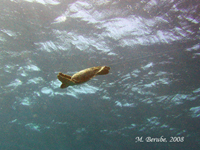 turtles. The first turtle was“Chip,”a 16.9- kg Hawksbill. After releasing this turtle with the buoy system attached, we let the animal travel for about an hour then,relocated the buoy system via the radio transmitter coupled to the data logger. It was exciting to be able to locate the system easily and quickly, but when we retrieved the buoy, the turtle had broken free of the tether. It was obvious that the line holding the breakaway loops to the turtle had been severed, since some of the loops of the breakaway were still in tact. That meant we needed to redesign the line on the turtle to withstand more pull.
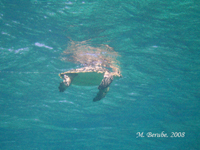 After a couple days, we were ready for a second trial. Our concern now was that the only turtle available might be too small to pull the system we’d designed. When we released the second trial turtle, we kept a close eye on it to see how it would fair with the system attached. Our concerns about the body to buoy weight ratio were correct and we eventually released the small turtle from the system, with the aim of going back to the drawing board to redesign a smaller, lighter system than we were able to construct on the island.
July 2008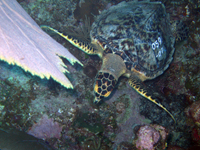
July saw the return of the research team to the Bay Islands with an improved and smaller buoy system than in March, ready to be deployed. There was still the need to use the system on larger,rather tan smaller, juveniles, since the system still weighed in at about 0.45 kg. Although we trialed the new system on an available turtle, we again found this animal too small for the system.
In the meantime, both Dunbar and Berube were engaged in speaking appointments with elementary and high schools around Roatan. The presentations were designed to increase awareness of sea turtles around the Bay Islands and also to introduce the new conservation initiative designed by ProTECTOR 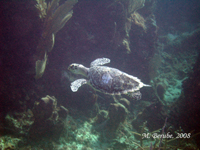 and supported by a State of the World’s Sea Turtles (SWOT) Outreach Grant. The initiative, called the “Nesting Turtle Hotline,” is a 24/7 hotline number that anyone can call when they see a turtle nesting, stranded, or injured on the beach. A trained response team will then attend to the turtle. We’ve developed a competition that involves the children of the schools on Roatan, ages 6 – 16, to promote the program and publicize the hotline number. The idea is to engage the children by getting them involved in this first step toward sea turtle conservation. Hopefully, many of them will influence their family and friends to recognize that “Turtles are our friends…”
August 2008
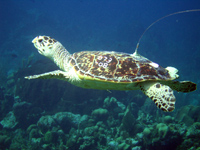
Melissa’s work continued with radio tracking, with one turtle 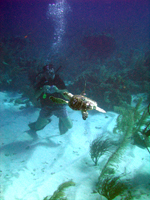 being added to the study this summer. It appears that several of the turtles that were part of the study last year have either lost their transmitters, or moved away from the area, because we were unable to locate them.
Steve Dunbar returned to Roatan in August. In addition to teaching a short field course there, we continued to tag, measure, weigh, and release several juvenile hawksbills and a few green turtles. We were able to follow several releases to record their activities through direct, in-water observations. Our first publication of these reports are available here as a PDF.
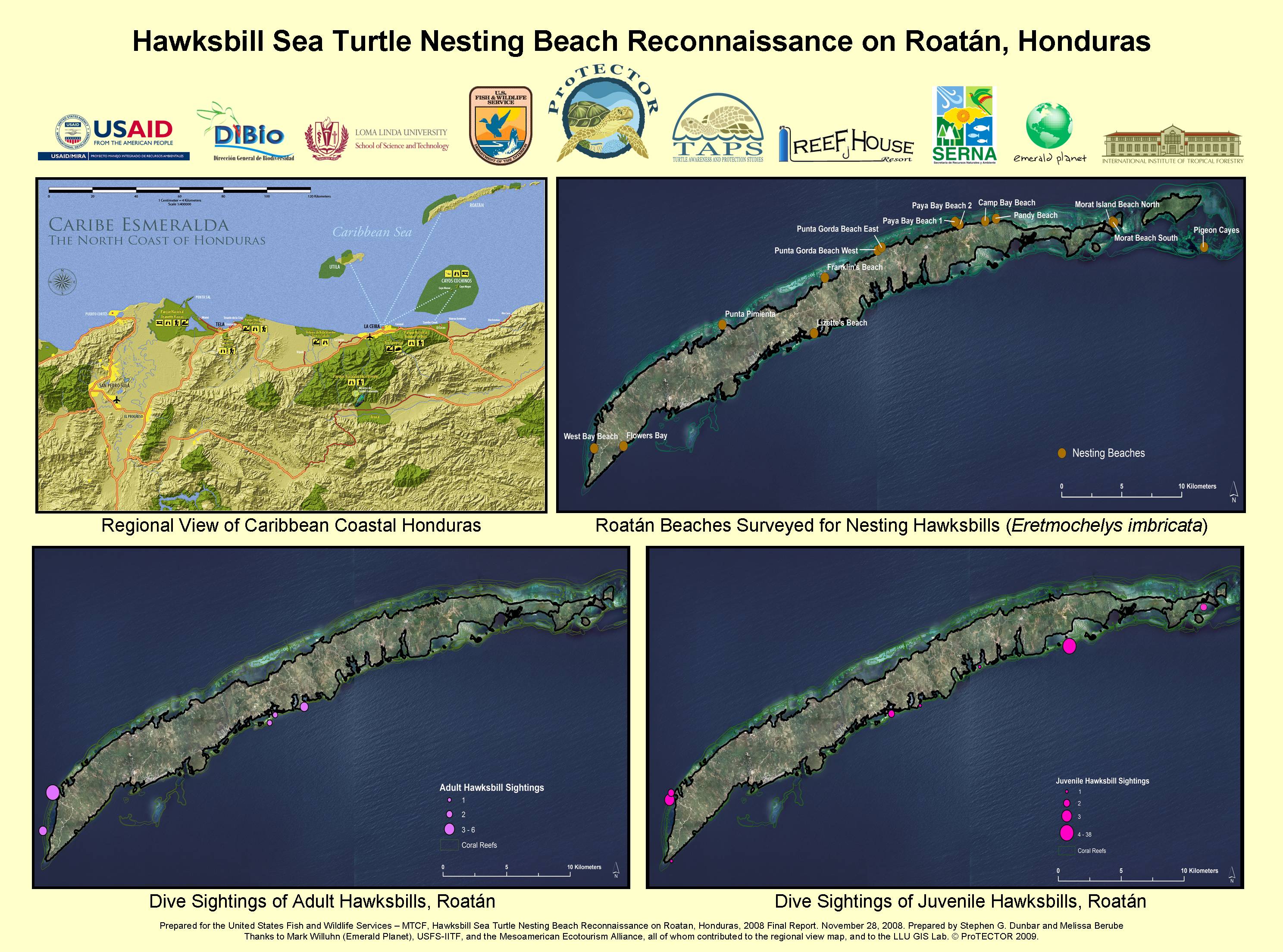
As a part of the hawksbill nesting beach reconnaissance project funded by the US Fish and Wildlife Service, we continued to search for evidence of nesting hawksbills on the beaches of Roatan, as well as on a very small, uninhabited island to the east of Roatan. We were unable to find any evidence there, although local community members suggested that the turtles do nest there later in the year. We will need to develop a season-long monitoring effort if we are to be able to discover where and when hawksbills may be nesting on a consistent basis on Roatan. Details of the entire hawksbill nesting beach reconnaissance project are provided in a report provided to the USFWS. You can access the report here as a PDF.
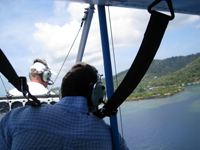
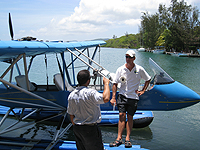 We were also able to continue our aerial surveys for turtles in the coastal zones around Roatan with the help of Bob and Clay of Bay Islands Airways. For both flights in August, we had additional help spotting turtles from ProTECTOR Board of Director, Sabine Dunbar, who managed to capture some of the sightings on video. These aerial surveys are one way we're able to determine where sea turtles are occurring in the immediate area.
Another system of active monitoring that we are working on is in collaboration with several of the dive operators on Roatan. Each operator is provided some brief training on how to identify turtle species, how to regularly fill in the data forms, and how to provide the sightings data to the TAPS program. This dive sightings program utilizes visiting divers to spot and record the species of turtles seen in local dive spots. The information is especially useful if collected regularly, allowing us to plot when and where turtles are showing up throughout the entire year. Eventually, we would like to have the full cooperation of all the dive operators on all the Bay Islands for this program.
Through support from another SWOT Outreach Grant, ProTECTOR worked through TAPS to launch the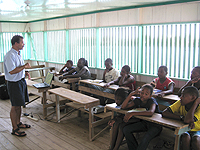 “Turtle Nesting Hotline Art and Jingle Challenge.” This competition was launched to publicize the Turtle Nesting Hotline. There is currently no mechanism for reporting the sightings of
 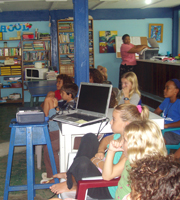 sea turtles on the beaches or in the waters of Roatan. TheHotline will provide a way for people all over the island to report when and where a sea turtle has been seen. Three teams of local partners will be trained to respond to the calls by attending to the turtle, or passing on the information to another team. To advertise the Hotline numbers, we challenged school children in Roatan to
 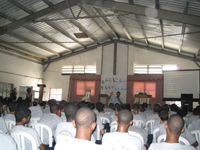 create art that represented turtles on the beach, as well as jingles that would help the public understand the need to protect turtles on the beaches and in the water. The contest was started in June and continued until November 5.
September 2008
In mid-September, Steve again returned to the Reef House Resort to continue studies with the turtles in the Bay Islands. Along with tagging and releasing new turtles, we continued to visit schools around the 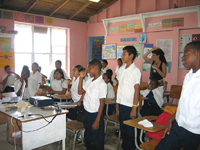 island to promote the Nesting Turtle Hotline Art and Jingle Challenge. In addition to Steve’s efforts to present talks to schools on Roatan, ProTECTOR enlisted the assistance of the Roatan Marine Park (RMP) to reach schools on the West end of Roatan. With the help of Grazzia Matamoros and RMP volunteers, we were able to reach out to more schools with increased awareness of sea turtle conservation efforts in Roatan, as well as the Challenge. See video of the Challenge below.
December 2008
From December 7 – 11, Steve returned to the Reef House Resort to spend some time training the new co-owner, Mr. Mike Pack, on tagging and data collection of turtles that come in when the research team is not on island. Fortunately for ProTECTOR and TAPS, Mike continues to fully support the conservation and research efforts the Stevensons and Kennewells have been involved with.
In December, we also had a visit from Jessica Pate, a volunteer with the Bay Islands Conservation Association (BICA) Utila. She spent three days with us discussing the possibilities of starting a turtle conservation/research project on Utila with the new Director, Marina Ocampo. This is a step that ProTECTOR is interested in taking to expand the TAPS program. We hope to work with BICA Utila in 2009 to initiate a program with them on Utila.
| Data Collectors |
| Bottles 2 Buildings |
| ResearchGate |
| ProTECTOR Inc. Youtube |
| Interns and Volunteers |
| ProTECTOR Store |